
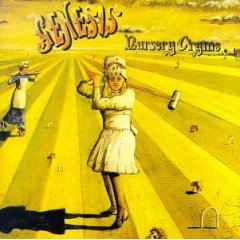
So, my first thought to myself when considering making this blog was what album to review first? I have decided to go with a "safe" album that I like almost the entirety of - Nursery Cryme, by Genesis.
The year was 1971, and Genesis had just become the shape that would be forever cherished among prog fans as easily their best. Peter Gabriel (vocals), Steve Hackett (guitar), Tony Banks (keyboards), Mike Rutherford (bass) and Phil Collins (drums). This combination was just amazing, pure and simple. Their creativity at this point was at an all-time peak, and this showed throughout all four of their albums together.
So, anyway, Nursery Cryme. Consisting of seven tracks, it's a prime example of how to do prog well in the 70s. I shall examine it now, track by track, for your reading pleasure. :P
01 - The Musical Box (10:33)
With a length of 10:33, one has got to wonder at the decision of having this as the opener. Not exactly the best way to settle an audience down into an album, with a monster like this. However, I shall go down on record as saying that this is one of the most interesting ten-minute-plus songs I've heard.
The song starts out with some signature acoustic work of Genesis - three guitars being played at the same time by Banks, Rutherford and Hackett. Probably the most beautiful part of the song, in my opinion. Beautiful harmonising by Gabriel and Collins here.
At 1:28, however, the tone changes - things take a subtle turn for a more dramatic feel. Just under the surface, the tension has increased. Gabriel comes in with flutework that compliments the guitars amazingly well - flutes work unbelievably well in bands, alongside guitars and drums. Should be used more often, haha.
3:40 is where the distortion kicks in, and what can be seen as probably the bulk of the song starts. Solo time for Rutherford here. Amazing how he's able to produce an interesting solo above a relatively static chord progression.
A little cool-down period, and then another solo kicks in. Same chord progression here, but more it definitely feels epic, I think. More interplay between instruments here. Some people may consider nearly two minutes of a solo a bit excessive - and I don't honestly blame them. However, this goes by incredibly fast, in my opinion.
Another soft section enters at 7:40. I think I'm seeing a pattern here...
The transitions here are tastefully done, btw - everything fits.
The final section starts at 8:36 - keyboard time for Banks, and it's clear that this is the climax of the song - as it should be. Can't really think of anything much more to say here - great interplay between the guitar and keyboard near the very end. Goes out with a bang.
And thus ends probably the best ten minutes of Genesis' career - I consider this to be their best song, even above Supper's Ready from Foxtrot - their other masterpiece.
9.4/10
02 - For Absent Friends (1:49)
And now we go from a long to a short song. Quite a pastoral song - echoes their previous work. Collins' debut as a lead vocalist on a Genesis song. Pleasant - a song that I don't skip when listening.
8.7/10
03 - The Return Of The Giant Hogweed (8:14)
This is one of their "heavier" songs - don't go thinking of comparisons with heavy metal or anything, though. Abrasive, perhaps, is a better word. This song details the story of the invasion of England by hogweed (a invasive weed, for the uneducated :P). By the song's end, they rein supreme over the human race.
Quite possibly a contender for the awesomest song title ever, it's an amusing listen. Banks' keyboard work is prominent throughout the mix, and provides an interesting listen throughout. Another song where I don't get bored, although it's probably not the most likeable song on the album. The most quirky on the album, I would say.
7.5/10
04 - Seven Stones (5:13)
My second favourite on the album, and the most-listened song as a result - since it's shorter than Musical Box. :P
One word - beautiful. Mellotron work here is just breathtaking, and it really does create a soundscape to behold (haha, get to actually use the blog's title. Wasn't sure if I would fit it in.)
Highlights include the incredibly simple yet beautiful mellotron solo at the end of the song, and the chorus. Just... listen to that chord progression! Simply brilliant - chord progressions are some of the things that catch my ear in music. An epic performance by Gabriel as well.
9.2/10
05 - Harold The Barrel (3:03)
I guess this is another humourous song - short and jangly, it's a fun listen. One thing to note in this song is the bass - sounds like Rutherford is having fun in this one.
7.4/10
06 - Harlequin (2:58)
Another song where I love the chord progression. Haunting. Another example of the pastoral sound of Genesis - just quiet acoustic work. This is mainly a duet with Gabriel and Collins, and probably my third favourite off the album.
8.8/10
07 - The Fountains Of Salmacis (7:55)
The closer for the album, it is a good representation of the whole album, as it rightfully should. A fine conclusion, but I don't find myself coming back to this song as much as I do to the others. Based in mythology, as per custom of 70s prog, I personally lump it together with Harold and Hogweed. The rest are right up there. I don't mean to say that they are bad songs, it's just that I don't actively seek them out to listen to.
7.7/10
So, this is one of the few albums that I can listen to the entirety of, and never get bored. That's quite an achievement - well, I think it is. :P
A good example of classic 70s British prog, it's an essential part of any prog collection. Overall, Genesis' best album, and their most consistant.
For those new to prog, and need an easy introduction to Genesis' prog days, Seven Stones, Harlequin and For Absent Friends are recommended from this album.
Overall album score: 8.4/10

No comments:
Post a Comment